The Design of the Commons - Scaling Cooperation
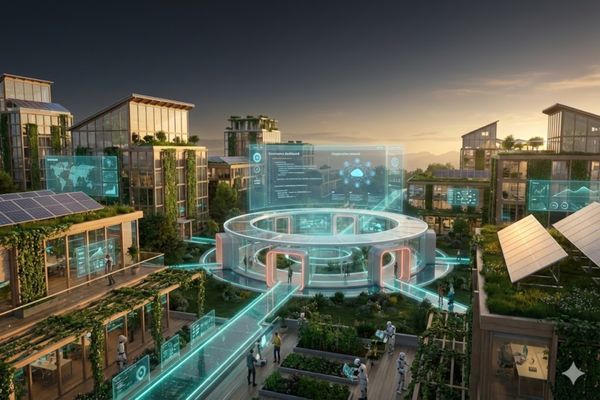
Exploring how Elinor Ostrom’s economic theories, Open Source culture, and Mutual AI can solve the "Tragedy of the Commons" and build a Post-Labor economy rooted in shared access.
10 Dec 2025
1. The Challenge of the Commons
The Tragedy of the Commons is often taught as if it were an unavoidable law—put people around a shared resource, and depletion is inevitable. But history tells a different story: the collapse of commons is not destiny but a design failure.
In 1968, ecologist Garrett Hardin popularized the idea that shared resources inevitably suffer overuse. His scenario was simple: if every farmer adds one cow to a common pasture, individual incentives outstrip collective responsibility, and the land is destroyed. From this, Hardin proposed only two solutions: full privatization or state control.
Then in 2009, Elinor Ostrom won the Nobel Prize by proving Hardin wrong in the most practical way possible—by studying real communities. Swiss grazing collectives, Japanese forest stewards, and Filipino irrigation networks had managed commons successfully for centuries through local rules, communication, and shared governance.
Ostrom showed that the “tragedy” is not inherent to commons; it emerges when systems lack trust, structure, and clear agreements.
Today, our commons are no longer just pastures and forests. They are digital networks, energy systems, and computational infrastructures. As we move deeper into the era of Post-Labor Mutualism, Ostrom’s principles offer a guide for designing shared abundance at planetary scale.
2. The New Scarcity: Computing Power and Energy
In the industrial age, the primary battleground of economics was land and factory machinery. In the age of Post-Labor Economics, where human labor is decoupled from value creation, the nature of "capital" shifts.
In a world of automation, the most valuable physical assets are computing power and energy.
If robots and algorithms are to perform the work of society—growing food, 3D-printing housing, balancing grids—they require immense amounts of electricity and processing cycles. These are the new "means of production."
If these assets remain the exclusive property of centralized corporations, we risk drifting into a form of digital feudalism where we rent the basics of life from tech giants. But if we view computing power and energy as Commons—resources to be stewarded collectively—we unlock a different future. We move from a logic of private accumulation to one of shared access, ensuring that the dividends of automation flow to the many, not the few.
Computing and energy form a coupled system: AI needs power to run, and modern energy systems increasingly rely on AI to balance, optimize, and distribute resources.
3. Open Source: The First Digital Mutualism
We don't have to look far to see if this model can work. We are already using it. The Free and Open Source Software (FOSS) movement is perhaps the most successful experiment in Mutualism in human history.
Consider the infrastructure of the modern world. The internet (Apache/Nginx), the cloud (Linux), and vast repositories of human knowledge (Wikipedia) are not owned by corporations. They are built and maintained by communities based on reciprocity and self-organization.
Open Source embodies the core ethics of Mutualism:
- Voluntary Association: Developers contribute not because they are coerced, but for utility, reputation, or the ethos of sharing.
- The Commons: The code is available to all; one person using Linux does not diminish its value for another—in fact, it often increases it (network effects).
- Meritocratic Governance: Decisions are made through "rough consensus and running code," not by boardroom decree.
However, FOSS has a limitation: it relies heavily on human labor and often struggles with funding. Post-Labor Mutualism seeks to take the ethics of Open Source and apply them to the physical world of energy and automation.
4. Digitizing Ostrom: From Village Rules to Smart Contracts
Ostrom’s principles worked in villages because everyone knew each other; social pressure prevented cheating. But how do we trust strangers in a global digital economy? The tools to scale the village commons to a planetary level are AI and blockchain.
This is where DAOs (Decentralized Autonomous Organizations) provide the architectural layer. Blockchain technology allows us to encode Ostrom’s principles into immutable software:
- Clearly Defined Boundaries: Token-gated access ensures the community knows who the members are.
- Collective Choice Arrangements: Voting mechanisms allow participants to change the rules of the protocol.
- Monitoring and Sanctions: Smart contracts can automatically penalize "free riders" or bad actors without the need for a central police force. AI allows for continuous, non-intrusive monitoring of resource flows, making one of Ostrom’s most difficult principles — effective oversight — radically easier to implement at scale.
We are replacing "village gossip" with transparent verification. By building platform cooperatives on DAO infrastructure, we create digital institutions that are as robust as corporations but governed like commons.
5. Mutual AI: The Neutral Steward
The final piece of the puzzle is Artificial Intelligence. Managing a global commons of energy and compute is too complex for manual human voting on every decision. We need Mutual AI.
Imagine an AI agent trained not to maximize engagement or profit, but to optimize for sustainability and fairness.
- It balances the load on a community microgrid to prevent blackouts.
- It allocates cloud computing resources to research projects based on priorities voted on by the DAO.
- It detects resource depletion before it happens and alerts the governance layer.
Unlike corporate AI, which is trained to maximize engagement or profit, Mutual AI is accountable to the community and optimizes for shared wellbeing.
In this model, AI acts as the steward, not the master. It is the librarian that ensures the books are organized and accessible, operating under the constitutional rules set by the community. For a deeper dive into how AI can align with shared values, researchers like those at the Center for Human-Compatible AI are exploring the safety systems we will need.
6. Reclaiming "You'll Own Nothing and Be Happy"
There is a now-infamous phrase that originated from a World Economic Forum prediction: "You'll own nothing, and you'll be happy". For many, this sounds like a dystopian warning—a future where we are stripped of property and forced to rent our lives from omnipotent corporations.
The fear behind the phrase is real: in a world dominated by corporate rentiers, “owning nothing” feels like a loss of autonomy. But there is another way to interpret this possibility—through the lens of Solarpunk and the Commons.
In a Post-Labor Mutualist future, you might not own a car, but you have guaranteed access to a fleet of autonomous vehicles owned by your community DAO. You might not own a generator, but you are a co-owner of the local solar grid. You might not own the server farm, but you hold governance rights in the digital cooperative that runs it.
We can find a way to make this concept part of a hopeful future: instead of relying on corporations, we will rely on commons institutions.
If the institutions are ours—if we hold the keys, the governance tokens, and the source code—then "owning nothing" individually means owning everything together. It is the shift from the burden of private ownership to the freedom of shared abundance.
7. The Architecture of Trust
The tragedy of the commons is not inevitable. It is a design challenge—one that arises in systems that lack communication and trust.
By combining the social insights of Elinor Ostrom, the collaborative culture of Open Source, and the verification power of DAOs and AI, we can build an economy that is resilient, fair, and abundant. We can build a world where the most valuable assets—energy, intelligence, and data—belong to the commons.
The code is being written. The question is whether we will write it together.
What kinds of commons — digital, ecological, or energetic — might your community be ready to build together?